1
2
3
4
5
6
7
8
9
10
11
12
13
14
15
16
17
18
19
20
21
22
23
24
25
26
27
28
29
30
31
32
33
34
35
36
37
38
39
40
41
42
43
44
45
46
47
48
49
50
51
52
53
54
55
56
57
58
59
60
61
62
63
64
65
66
67
68
69
70
71
72
73
74
75
76
77
78
79
80
81
82
83
84
85
86
87
88
89
90
91
92
93
94
95
96
97
98
99
100
101
102
103
104
105
106
107
108
109
|
# TinyUSB

[](https://github.com/hathach/tinyusb/actions) [](https://opensource.org/licenses/MIT)
TinyUSB is an open-source cross-platform USB Host/Device stack for embedded system, designed to be memory-safe with no dynamic allocation and thread-safe with all interrupt events are deferred then handled in the non-ISR task function.
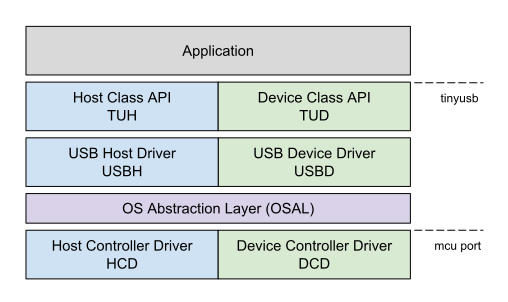
```
.
├── docs # Documentation
├── examples # Sample with Makefile build support
├── hw
│ ├── bsp # Supported boards source files
│ └── mcu # Low level mcu core & peripheral drivers
├── lib # Sources from 3rd party such as freeRTOS, fatfs ...
├── src # All sources files for TinyUSB stack itself.
├── test # Unit tests for the stack
└── tools # Files used internally
```
## Contributors
Special thanks to all the people who spent their precious time and effort to help this project so far. Check out the
[CONTRIBUTORS.md](CONTRIBUTORS.md) file for the list of all contributors and their awesome work for the stack.
## Supported MCUs
The stack supports the following MCUs:
- **Dialog:** DA1469x
- **Espressif:** ESP32-S2
- **MicroChip:** SAMD11, SAMD21, SAMD51, SAME5x, SAMG55
- **NordicSemi:** nRF52833, nRF52840
- **Nuvoton:** NUC120, NUC121/NUC125, NUC126, NUC505
- **NXP:**
- iMX RT Series: RT1011, RT1015, RT1021, RT1052, RT1062, RT1064
- Kinetis: KL25
- LPC Series: 11Uxx, 13xx, 175x_6x, 177x_8x, 18xx, 40xx, 43xx, 51Uxx, 54xxx, 55xx
- **Raspberry Pi:** RP2040
- **Renesas:** RX63N
- **Silabs:** EFM32GG12
- **Sony:** CXD56
- **ST:** STM32 series: L0, F0, F1, F2, F3, F4, F7, H7 both FullSpeed and HighSpeed
- **TI:** MSP430
- **[ValentyUSB](https://github.com/im-tomu/valentyusb)** eptri
[Here is the list of supported Boards](docs/boards.md) that can be used with provided examples.
## Device Stack
Supports multiple device configurations by dynamically changing usb descriptors. Low power functions such like suspend, resume, and remote wakeup. Following device classes are supported:
- USB Audio Class 2.0 (UAC2) still work in progress
- Bluetooth Host Controller Interface (BTH HCI)
- Communication Class (CDC)
- Device Firmware Update (DFU): only Runtinme
- Human Interface Device (HID): Generic (In & Out), Keyboard, Mouse, Gamepad etc ...
- Mass Storage Class (MSC): with multiple LUNs
- Musical Instrument Digital Interface (MIDI)
- Network with RNDIS, CDC-ECM (work in progress)
- USB Test and Measurement Class (USBTMC)
- Vendor-specific class support with generic In & Out endpoints. Can be used with MS OS 2.0 compatible descriptor to load winUSB driver without INF file.
- [WebUSB](https://github.com/WICG/webusb) with vendor-specific class
## Host Stack
**Most active development is on the Device stack. The Host stack is under rework and largely untested.**
- Human Interface Device (HID): Keyboard, Mouse, Generic
- Mass Storage Class (MSC)
- Hub currently only supports 1 level of hub (due to my laziness)
## OS Abstraction layer
TinyUSB is completely thread-safe by pushing all ISR events into a central queue, then process it later in the non-ISR context task function. It also uses semaphore/mutex to access shared resources such as CDC FIFO. Therefore the stack needs to use some of OS's basic APIs. Following OSes are already supported out of the box.
- **No OS** : Disabling USB IRQ is used as way to provide mutex
- **FreeRTOS**
- **Mynewt** Due to the newt package build system, Mynewt examples are better to be on its [own repo](https://github.com/hathach/mynewt-tinyusb-example)
## Getting Started
[Here are the details for getting started](docs/getting_started.md) with the stack.
## Porting
Want to help add TinyUSB support for a new MCU? Read [here](docs/porting.md) for an explanation on the low-level API needed by TinyUSB.
## License
MIT license for all TinyUSB sources `src` folder, [Full license is here](LICENSE). However, each file is individually licensed especially those in `lib` and `hw/mcu` folder. Please make sure you understand all the license term for files you use in your project.
## Uses
TinyUSB is currently used by these other projects:
- [Adafruit nRF52 Arduino](https://github.com/adafruit/Adafruit_nRF52_Arduino)
- [Adafruit nRF52 Bootloader](https://github.com/adafruit/Adafruit_nRF52_Bootloader)
- [Adafruit SAMD Arduino](https://github.com/adafruit/ArduinoCore-samd)
- [CircuitPython](https://github.com/adafruit/circuitpython)
- [Espressif IDF](https://github.com/espressif/esp-idf)
- [MicroPython](https://github.com/micropython/micropython)
- [mynewt](https://mynewt.apache.org)
- [Raspberry Pi Pico SDK](https://github.com/raspberrypi/pico-sdk)
- [TinyUF2 Bootloader](https://github.com/adafruit/tinyuf2)
- [TinyUSB Arduino Library](https://github.com/adafruit/Adafruit_TinyUSB_Arduino)
|
